

AI in Christian Academia: ORU’s Dr. Andrew Lang on the Potential and the Pitfalls
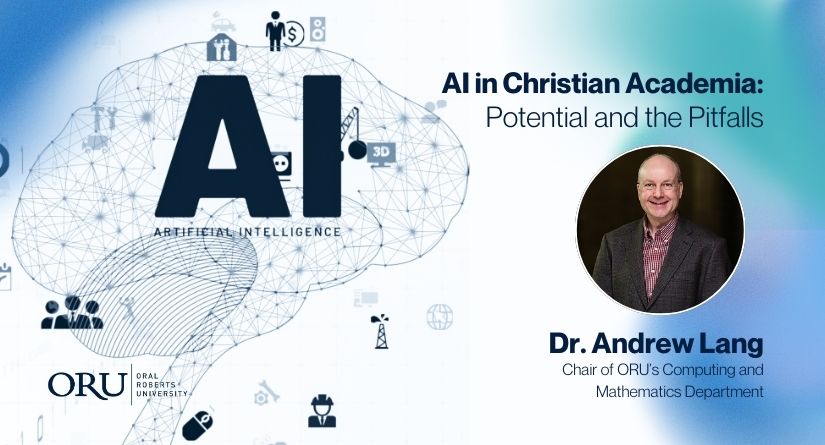
Tulsa, Oklahoma, February 11, 2025—Highlights from “Navigating AI in Christian Higher Education,” featuring Dr. Andrew Lang, Chair of ORU’s Computing and Mathematics Department, and
published in “Advance,” the print magazine of the Council for Christian Colleges & Universities (CCCU).
Beyond Data Points: Preserving Human Complexity
In 2025, businesses, schools, and individuals are learning to harness the power of AI to foster innovation, growth, productivity, and profits. On college campuses, this evolving technology has sparked a rethinking of both education and curriculum. While students can benefit from AI-driven analysis, content generation, and personalized learning, faculty are grappling with concerns such as plagiarism and a diminishing willingness among students to engage deeply with reading and research.
 “I see a growing trend of viewing human beings in terms of information,” Dr. Lang
said, “especially as we develop models that replicate human decision-making. There
is undeniable potential in this approach. By reducing human behavior to data, we can
design more efficient systems and make significant strides in medicine, education,
and beyond. However, what may be sacrificed is the recognition of the full complexity
of human experience—something that transcends the data we generate or the mental tasks
we perform. While AI has made impressive progress, particularly through the pursuit
of Artificial General Intelligence (AGI), these systems currently reflect and recycle
existing human knowledge rather than generate original, creative thought.”
“I see a growing trend of viewing human beings in terms of information,” Dr. Lang
said, “especially as we develop models that replicate human decision-making. There
is undeniable potential in this approach. By reducing human behavior to data, we can
design more efficient systems and make significant strides in medicine, education,
and beyond. However, what may be sacrificed is the recognition of the full complexity
of human experience—something that transcends the data we generate or the mental tasks
we perform. While AI has made impressive progress, particularly through the pursuit
of Artificial General Intelligence (AGI), these systems currently reflect and recycle
existing human knowledge rather than generate original, creative thought.”
From AGI to Strong AI: A Potential Ethical Frontier
 In discussing the future of AI, Dr. Lang noted the distinction between AGI and so-called
“Strong AI.” AGI refers to systems that can understand or learn any intellectual task
a human being can. Dr. Lang believes we may see AGI within the next decade—an achievement
that would revolutionize sectors from healthcare to finance. While speaking with CCCU,
Dr. Lang urged Christians and educators to look even further ahead to Strong AI.
In discussing the future of AI, Dr. Lang noted the distinction between AGI and so-called
“Strong AI.” AGI refers to systems that can understand or learn any intellectual task
a human being can. Dr. Lang believes we may see AGI within the next decade—an achievement
that would revolutionize sectors from healthcare to finance. While speaking with CCCU,
Dr. Lang urged Christians and educators to look even further ahead to Strong AI.
“What sets us apart,” Dr. Lang said, “is not just our cognitive abilities but our intrinsic personhood and the richness that machines, at present, cannot replicate. As the race toward AGI continues, I believe we may well achieve this milestone within the next decade—a remarkable and transformative possibility. However, my deeper concern lies with the development of ‘Strong AI,’ an intelligence that not only mirrors human reasoning but also simulates consciousness and self-awareness, potentially possessing mental states, beliefs, desires, and emotions akin to humans. This prospect, more than AGI itself, is where the true ethical and existential questions begin.”
Implications for Christian Higher Education
For faculty and students alike, the practical implications of AI are already substantial. Data analysis, machine learning, and programming skills will increasingly become foundational, ensuring that graduates can leverage new tools in creative and productive ways.
“As AI tools become more powerful,” Dr. Lang said, “they are streamlining data analysis and decision-making, allowing professionals to focus on more creative and strategic tasks. For now, students will need to develop a blend of technical skills—data science, machine learning, and programming—alongside their core expertise to harness AI effectively.”
However, these enhancements are only a first step in a longer AI journey.
“In my view,” Dr. Lang continued, “the current impact of AI is only temporary. As we move toward the development of Strong AI, the landscape will change dramatically. Human qualities like creativity and ethical reasoning will remain important, but they will be challenged in ways we can’t yet fully predict. The advent of AGI and Strong AI will likely demand a different kind of thinking—one that is not limited by the tools and techniques of today but is prepared to address the profound shifts that AI could bring to our understanding of intelligence, personhood, and the nature of work itself.”

A Christian Response: What Does It Mean to Be Human?
As society edges closer to sophisticated forms of AI, Dr. Lang envisions debates around granting “rights” and “personhood” to machine intelligence. In his publication with CCCU, he said:
“I foresee the emergence of human-level Strong AI within the next 30 years, bringing with it profound questions about ‘rights’ and ‘personhood.’ I anticipate that the secular world will gradually begin to advocate for ‘rights’ for these machines, challenging us to contemplate even more deeply what it truly means to be human.”
Several questions can be raised, such as:
- As Christians, how should we respond?
- Should we extend certain entitlements and privileges to AI entities and machines?
While these are weighty questions, Dr. Lang also went on to stress that as AI progresses, spiritual identity becomes even more important.
 “Humanity is undeniably unique. We are created in the image of God, which grants us
a dignity and purpose that far exceeds mere biological existence. Our uniqueness doesn’t
just lie in our intellect or creativity, but in the fact that we are spiritual beings,
intrinsically connected to the Divine. This profound spiritual nature sets us apart,
elevating us beyond any machine, no matter how advanced. Unlike AI, we are not simply
processors of information; we are beings capable of love, empathy, and a deep, moral
consciousness.”
“Humanity is undeniably unique. We are created in the image of God, which grants us
a dignity and purpose that far exceeds mere biological existence. Our uniqueness doesn’t
just lie in our intellect or creativity, but in the fact that we are spiritual beings,
intrinsically connected to the Divine. This profound spiritual nature sets us apart,
elevating us beyond any machine, no matter how advanced. Unlike AI, we are not simply
processors of information; we are beings capable of love, empathy, and a deep, moral
consciousness.”
UNIVERSITY BRIEF
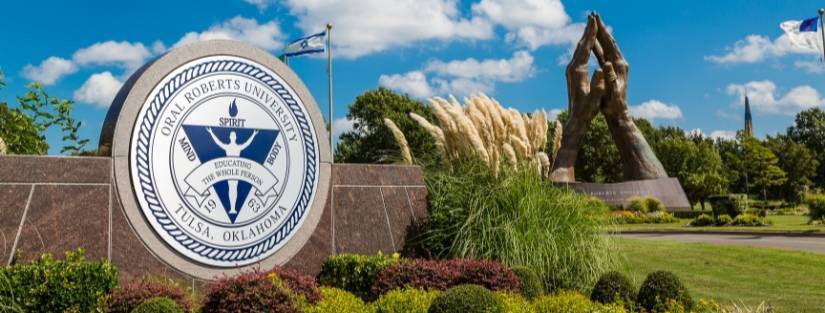
ORU is a Christian, Spirit-empowered, interdenominational university in Tulsa, Oklahoma, with 16 years of consecutive enrollment growth. Regionally accredited by the Higher Learning Commission, ORU offers over 150 majors, minors, concentrations, and pre-professional programs at the bachelor’s level, ranging from business and engineering to nursing, ministry, and more. Under the leadership of President Dr. William Wilson, ORU is preparing students from all 50 states and 165 nations in the last 5 years to be whole leaders for the whole world.
The Wall Street Journal ranked ORU as the #8 university in the nation for student experience and one of America's Best Colleges (2025). This new category rates the best colleges in the U.S. to have a great experience while attending. This ranking is powered by one of the largest-ever independent surveys of verified college students and recent graduates in the United States. Niche has recognized ORU as one of the top 25 most diverse colleges in America, the # 1 best Christian college in Oklahoma, and the # 1 in Oklahoma for diversity. Princeton Review ranked ORU as the best regional college, and College Raptor ranked ORU as a Hidden Gem in the Southwest. Heritage.org classified ORU as a great option for families prioritizing freedom, opportunity, and civil society.
ORU has been ranked by U.S. News & World Report as:
- #1 in Undergraduate Teaching
- #2 in Most International Students
- #3 in Best Value
- #6 in Best College for Veterans
- #7 in Best Regional Colleges in the West
For more information, visit www.oru.edu.